
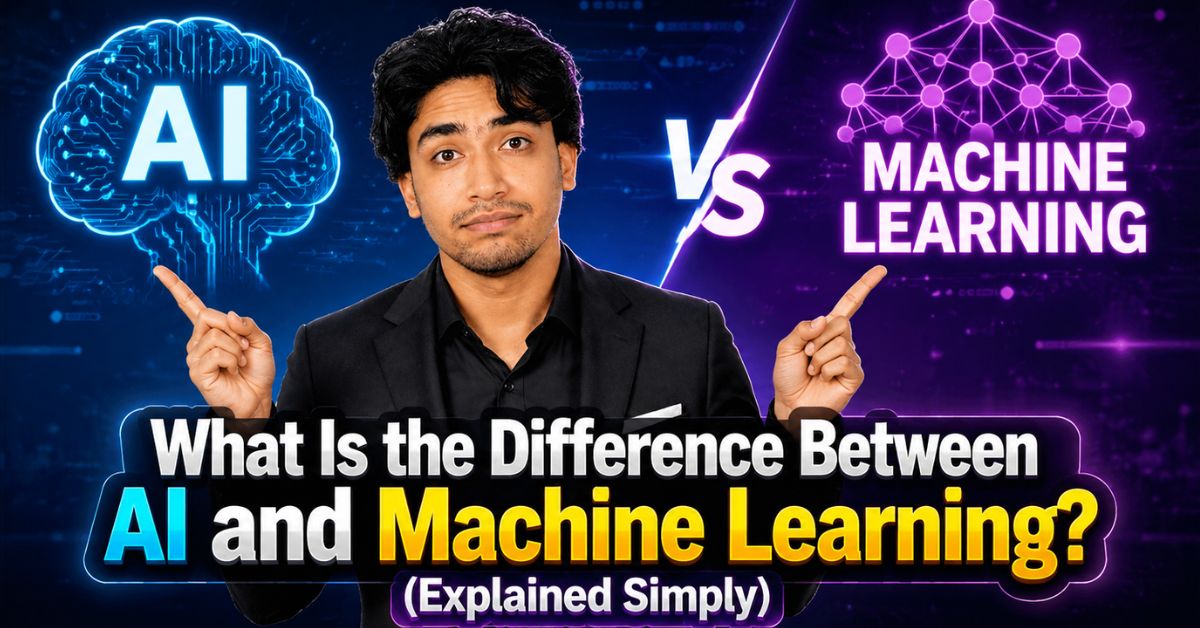
What Is the Difference Between AI and Machine Learning? Both are used interchangeably in so many places; peruse any job description, read any headline, look at any product description, or join any conversation, and you’ll find it. These two are used interchangeably every single time — whether in a job application, in news headlines, on product descriptions,s or in casual conversation.
Misspellings of “AI”, “machine learning,” or “deep learning.” Most people nod their heads with little idea of which is which or if it means different things. They mean different things, however. Clarifying the difference between AI and machine learning makes a lot of what’s going on in tech feel a lot more comprehensible — from ChatGPT to self-driving cars to the next movies you see on your Netflix queue.
Let’s get the issue crystal clear.
The Simple Version First
Artificial Intelligence (AI) is the general concept of programming computers to perform tasks that normally involve human intelligence, such as understanding language, identifying images, making decisions, and solving problems.
Machine Learning (ML) is one particular approach to getting AI — one situation in which you develop thousands of examples for the system to learn, without having to program each rule manually.
Their relationship is simple: All Machine learning is AI, but not all AI is machine learning. AI is the goal. One of the primary paths to this is machine learning.
Even then, it may not seem all that clear, so let’s help flesh this out with an analogy.
The Teaching Analogy
Suppose you have a system that can identify pictures of cats.
One of the traditional forms of AI is referred to as ‘rule-based AI’, where the programmer hand-codes the rules, e.g. cats have four legs, fur, pointed ears, whiskers. The system examines each photo to make the decision whether it is a cat or not. This was fine for problems with a dog without folded ears and a cat without folded ears, but broke down as soon as it came to photographing a cat with folded ears, or a dog with a cat’s face.
The machine learning method is a completely different one! You teach the system a million images; half are ‘cat’ images and half are ‘not cat’ images, and let it learn from them. Once a lot of examples, it forms its own internal sense of what it is like to be a cat. It could discern within itself patterns that no human programmer would have ever thought to put. And it copes with the unusual cases better, since it was taught real variation instead of simplified rules.
Learning from examples, that’s called machine learning.
Where Deep Learning Fits In
Another term you’ve likely already heard is ‘deep learning’—and it is fittingly placed here as it is constantly mentioned.
Deep learning is a machine learning technique using structures loosely based on the human brain (called neural networks) to find patterns in very large and complex sets of data. It’s the magic behind nearly every cool thing that’s happening in AI these days: ChatGPT’s language comprehension, unlocking your phone using your face, generating images from text descriptions, and more.
Therefore,e the complete hierarchy of symbols is:
- AI the → general goal of machine intelligence is to. To achieve the broad goal of machine intelligence, AI is needed to.
- Machine Learning → one method of achieving AI (learning from data)
- Deep Learning → one powerful type of machine learning (using neural networks)
There are several dolls inside each other, like Russian dolls.
What Is the Difference Between AI and Machine Learning?: Real Examples of Each
Rule-based AI (AI without machine learning):
An earlier chess program from the 1990s that followed rules that had to be hand-coded by humans as to whether the move was good or bad. A spam filter which prevents the receipt of spam e-mails that include certain words on the “flag” list.
A chatbot for customer service, resembling keyword matching a pre-written response. This type of system is only in a limited sense intelligent and unable to adapt or improve without human intervention.
Machine Learning:
What Netflix learned about your tastes was based on the preferences of millions of others who viewed similar programs in the past, with similarity found via its recommendation tool (no one programmed “if someone likes crime dramas, give them thriller documentaries”).
That is a system’s inference based on data. Credit Card Fraud Detection is similar — it gets a sense of “normal” transactions, and when it sees something that it detects as fraud, it gains the information, then it learns what is normal.
Deep Learning:
The language understanding in ChatGPT. New image recognition feature that automatically collects photos of the same person in Google Photos. Voice activation of Siri and Google Assistant. Chatting with Google Translate in real-time.
These are all problem-solving tasks where you need to identify patterns that are far too complex for any other type of program to reliably process except a deep neural network, which has been well trained and fed with lots of data.
Why the Terms Get Confused
The No. 1 confusion between AI and machine learning is that in 2026, practically 100% of the useful AI is based on machine learning, more precisely deep learning. When people speak of AI, they are invariably referring to something created with machine learning.
This may be more important for the builders of these systems than for those using them. However, knowing the term helps you to understand and avoid all the marketing buzz of “AI-powered” being everything from just an autocomplete on a search bar to a really advanced reasoning system.
Not all AI is performed via machine learning. Measuring the temperature when cooling starts below a target is intelligent, but it’s learned by a simple rule, not a learned model. It’s not like ChatGPT or any image recognition software: it is indeed AI, but a very different kind.
The Part That Actually Matters Right Now
The dizzying progress in AI capability that everyone is experiencing in an abrupt manner is the result of moving from rule-based systems to machine learning — in particular, deep learning. Decades ago, the capability of a rule-based system reached a standstill.
They came in handy, but they lacked a few things. With the computational power and the data, machine learning scaled upwards in a way many did not realize.
AI does not make for a great washer if someone created superior rules for how it should respond to questions. If somebody wrote superior rules for how to answer questions, ChatGPT is not impressive. The reason it becomes impressive is that a deep learning algorithm was trained with hundreds of billions of words, learned a model of language that no one in particular programmed into it; that model was formed out of the learning process itself.
What is the difference between AI and machine learning? The key difference between the old and the new era of AI. Machine learning, and more specifically deep learning, is the power behind nearly everything.
Quick Reference
| Term | What It Means | Example |
| Artificial Intelligence | Making machines do human-like tasks | Any smart computer system |
| Machine Learning | Teaching systems by showing examples | Netflix recommendations |
| Deep Learning | ML using neural networks for complex data | ChatGPT, image recognition |
| Rule-based AI | Intelligence from hand-written rules | 1990s chess programs |
Though the terms are interchangeable, what is the difference between AI and machine learning is real and in no way insignificant — not because people will make AI and machine learning contrastingly, rather, it’s simply to understand and to be able to comprehend the technology that is impacting almost every industry in the current times.